🟢 Open Source & Privacy-Focused
Jami
Jami is a fully decentralized messenger that works without any central servers. It connects users directly, which makes it highly private but sometimes less stable.
-
Server: No central server (peer-to-peer)
-
Location: Canada
-
Pros: Very high privacy, no central control, fully decentralized
-
Cons: Small user base, occasional connection issues
Tox
Tox is a peer-to-peer messaging platform designed for anonymity and security. It does not rely on servers and stores no user data, but it is not widely used.
-
Server: Peer-to-peer
-
Location: No central organization
-
Pros: Anonymous use, no data storage, decentralized
-
Cons: Limited development, few users
Briar
Briar is built for maximum security and can even work without internet using local connections. It is especially useful in restricted environments but has limited features.
-
Server: No server (Tor, Bluetooth, Wi-Fi)
-
Location: United Kingdom
-
Pros: Extremely secure, works offline, censorship-resistant
-
Cons: Android only, limited functionality
Element (Matrix)
Element uses the Matrix protocol, allowing users to choose or host their own servers. It offers flexibility and strong encryption but may be difficult for beginners to configure.
-
Server: Decentralized (self-hostable)
-
Location: UK / EU
-
Pros: Flexible, federated system, strong security
-
Cons: Complex setup
Conversations (XMPP)
Conversations is based on the open XMPP standard and allows decentralized communication. Users can select their own server, which gives flexibility but leads to varying quality.
-
Server: Decentralized (XMPP network)
-
Location: Depends on server
-
Pros: Open standard, user control
-
Cons: Inconsistent performance
Nextcloud Talk
Nextcloud Talk is designed for self-hosting, giving users full control over their data. It integrates well into private cloud environments but requires technical setup.
-
Server: Self-hosted
-
Location: Depends on hosting
-
Pros: Full data ownership, privacy-friendly
-
Cons: Requires technical knowledge
Rocket.Chat
Rocket.Chat is an open-source communication platform often used by companies. It offers flexibility and customization but is more complex to deploy.
-
Server: Self-hosted or cloud
-
Location: USA
-
Pros: Customizable, business-friendly
-
Cons: Complex setup
Delta Chat
Delta Chat uses email infrastructure for messaging, making it decentralized by design. It is simple to use but depends on the performance of email servers.
-
Server: Email servers
-
Location: Depends on provider
-
Pros: No new account needed, decentralized
-
Cons: Slower messaging speed
Signal
Signal is a centralized messenger known for its strong encryption and privacy focus. It is widely recommended but requires a phone number to register.
-
Server: Centralized
-
Location: USA
-
Pros: Strong end-to-end encryption, highly secure
-
Cons: Phone number required
Wire
Wire is a secure messaging app from Switzerland with strong privacy protections. It is suitable for both private and business use but has fewer users.
-
Server: Centralized
-
Location: Switzerland
-
Pros: High security, EU privacy standards
-
Cons: Smaller user base
🟡 Hybrid Solutions
Telegram
Telegram is a popular messaging app with many features and fast performance. However, end-to-end encryption is not enabled by default for regular chats.
-
Server: Centralized
-
Location: Dubai (company)
-
Pros: Fast, feature-rich, large groups
-
Cons: Weak default encryption
Threema
Threema focuses on privacy and does not require a phone number. It is based in Switzerland but requires a one-time purchase.
-
Server: Centralized
-
Location: Switzerland
-
Pros: Anonymous use, strong privacy
-
Cons: Paid app
Keybase
Keybase combines messaging with cryptographic identity verification. It is powerful but mainly suited for advanced users.
-
Server: Centralized
-
Location: USA
-
Pros: Strong encryption, identity system
-
Cons: Slower development
🔴 Proprietary Platforms
WhatsApp
WhatsApp is one of the most widely used messaging apps worldwide. It offers encryption but collects metadata and is owned by Meta.
-
Server: Centralized
-
Location: USA (Meta)
-
Pros: Huge user base, easy to use
-
Cons: Data collection, privacy concerns
Messenger (Facebook)
Facebook Messenger is tightly integrated with social media. It offers many features but lacks strong privacy protections by default.
-
Server: Centralized
-
Location: USA (Meta)
-
Pros: Widely used, many features
-
Cons: Weak privacy
WeChat
WeChat is an all-in-one platform combining messaging, payments, and social media. It is heavily monitored under Chinese regulations.
-
Server: Centralized
-
Location: China
-
Pros: Many features, widely used in China
-
Cons: Surveillance, censorship
Discord
Discord is designed for communities and offers voice, video, and text communication. It is easy to use but lacks end-to-end encryption.
-
Server: Centralized
-
Location: USA
-
Pros: Great for communities, flexible
-
Cons: No strong privacy
Skype
Skype is a long-standing communication platform by Microsoft. It provides stable calls but is considered outdated compared to newer apps.
-
Server: Centralized
-
Location: USA (Microsoft)
-
Pros: Reliable, well-known
-
Cons: Outdated, weaker privacy
Slack
Slack is a business-focused messaging platform with many integrations. It is powerful for teamwork but does not offer end-to-end encryption.
-
Server: Centralized
-
Location: USA
-
Pros: Excellent for teams, productivity tools
-
Cons: No end-to-end encryption
🧾 Conclusion
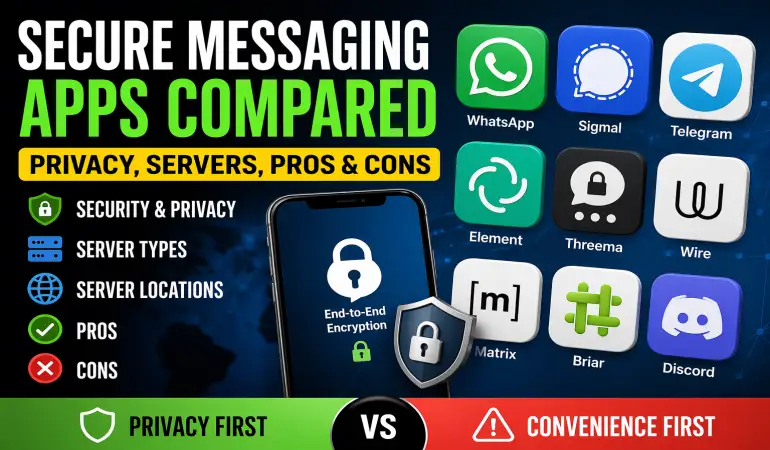
Messaging apps vary greatly in how they handle privacy, data, and infrastructure. Decentralized solutions provide the highest level of control, while centralized apps focus on usability and scale. The best choice depends on whether you prioritize privacy, convenience, or widespread adoption.